Understanding the benefits
- High power-to-weight ratio, meaning that they have the ability to move relatively substantial loads compared to their small footprint.
- They are very reliable, if used under the recommended parameters, and can last for millions of cycles.
- The phase transformation is a silent operation which is beneficial for many applications.
- Provide improved design flexibility because fewer parts are needed, allowing for a smaller design footprint.
End uses
- Locking/latching systems
- Vents/valves
- Pumps
- Optical image stabilization in smartphone cameras
- Safety relief valve for fire protection
- Interior comfort systems (lumbar support)
Shape memory effect
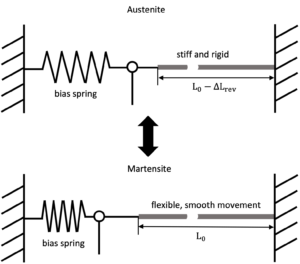
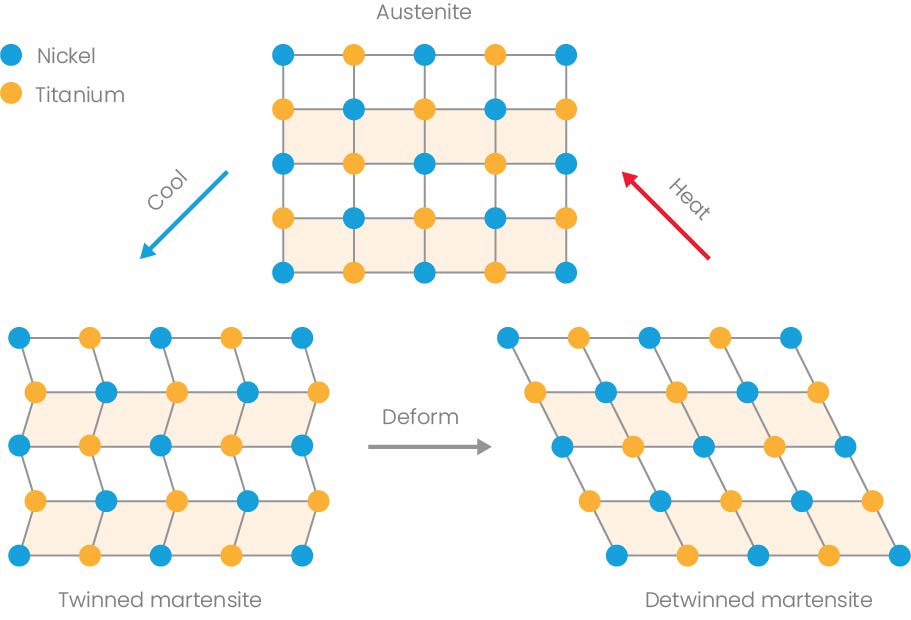
Nitinol exhibits a phase transformation and alters its atomic structure in response to temperature and applied stress. This phase transformation allows the material to “remember” its shape upon heating. At room temperature, the material transforms to the martensite phase and can be easily deformed or stretched. Upon heating, the wire will transform to the austenite phase and will return to its original, pre-deformed shape.
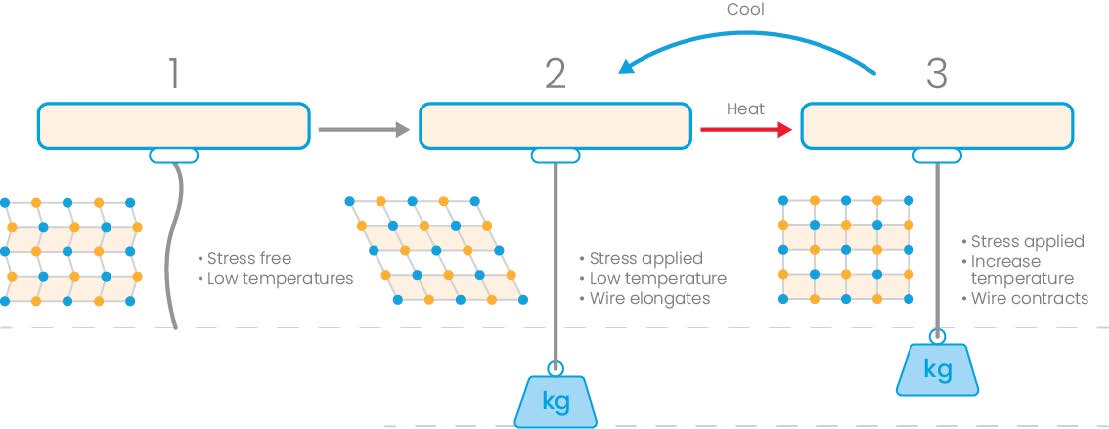
Simple linear Nitinol wire actuator
At room temperature with no stress applied, the Nitinol actuator wire is in the martensite phase. A load is applied, and the wire elongates. Upon heating (either via environmental temperature change or with current), the wire transforms to austenite and returns to its original pre-deformed length, lifting the object in the process.
The difference between Nitinol actuator wire and straight annealed Nitinol wire
Fort Wayne Metals’ actuator wire is processed specifically to tailor the properties of the Nitinol for use in actuator applications. This ensures the following:
- Functional stability wire will actuate/reset at the same temperature and achieve the same amount of stroke, cycle after cycle
- Dimensional stability no noticeable residual wire elongation after multiple actuation cycles
- Optimal actuation performance decreased reset time after being heated for actuation and greater work output
How is our actuator wire characterized?
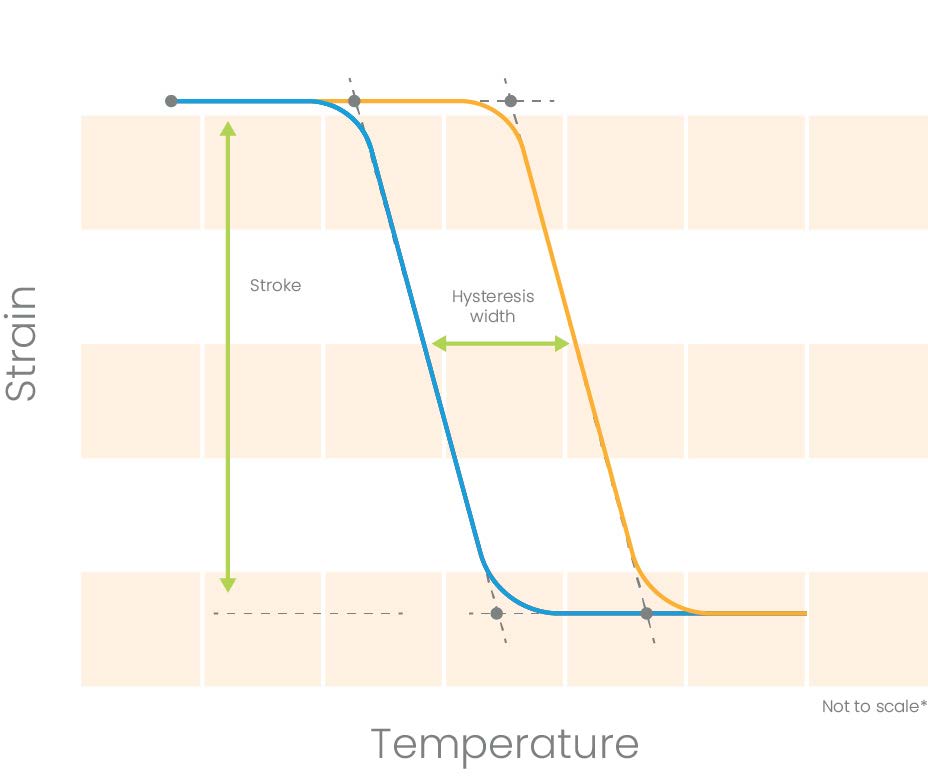
The actuator wire is held at a constant stress and subjected to a heating and cooling cycle. The amount of strain or “stroke” of the wire is monitored with a change in temperature (see ASTM E3097). Unless otherwise specified, Fort Wayne Metals’ actuator wire is characterized with an applied stress of 150 MPa.
- Hysteresis width the difference between the austenite and martensite transformation temperatures. This temperature delta corresponds to how quickly the actuator will reset after being heated for actuation.
- Austenite start temperature (Aₛ) the temperature at which the material starts to transform to austenite and contract under a given load. Also referred to as the “actuation start” temperature in actuator applications.
- Austenite finish temperature (Aᶠ) the temperature at which the material has transformed to austenite and the wire is fully contracted under a given load.
- Martensite start temperature (Mₛ) the temperature at which the material starts to transform back to martensite and elongates under a given load.
- Martensite finish temperature (Mᶠ) the temperature at which the material has transformed to martensite and is fully elongated under a given load. The actuator wire is now reset and can be heated again for actuation.
- Stroke the overall change in length of the wire as a result of the material phase transformation divided by the original length. Typically reported as a strain percentage.